
How do you know the automation actually saved anything?
Everyone says automation saves time. Ask how much and the room goes quiet. Here is how the number is worked out, and how you check it yourself.

You work it out before you build, not after. Take one job, count how many times it runs in a month, time the people who do it today at a normal pace, and put an hourly rate against them. Runs multiplied by minutes gives you hours. Hours multiplied by the rate gives you money. Then write the basis down in one plain sentence so anyone in the business can argue with it. The reason most businesses cannot answer the question is that their first artificial intelligence was a chat window, and a chat window saves time inside a task you are still doing by hand. Nothing counted it. Once the same intelligence sits inside an automated process, the work has a shape, and a shape can be measured.
Everyone says automation saves time. Ask how much, and the room goes quiet. The number is either missing, or it is a round figure somebody felt was about right, and neither of those survives a conversation with the person who signed the invoice.
Why can’t you feel the saving?
For most businesses the first artificial intelligence they meet is a chat window, and a chat window genuinely does save time. It also hides the saving completely.
Think about what actually happens. You open the tab. You work out what to ask. You type the question. You read what comes back. You judge whether it is any good. You copy it out and put it where it needed to go. That is still a manual task from start to finish, and the machine only helped with the middle of it. The time saved is real, and it is buried inside a person’s afternoon along with the other twenty things they did, and nothing wrote it down.
So when the question comes and nobody can answer it, that is not evidence the tool is useless. It is evidence that nothing about the way it is used can be counted.
What changes when it runs itself?
Put the same intelligence inside an automated process and the work takes on a shape. There is a trigger. There is a number of times it runs. There is a fixed set of steps and an agreed definition of finished.
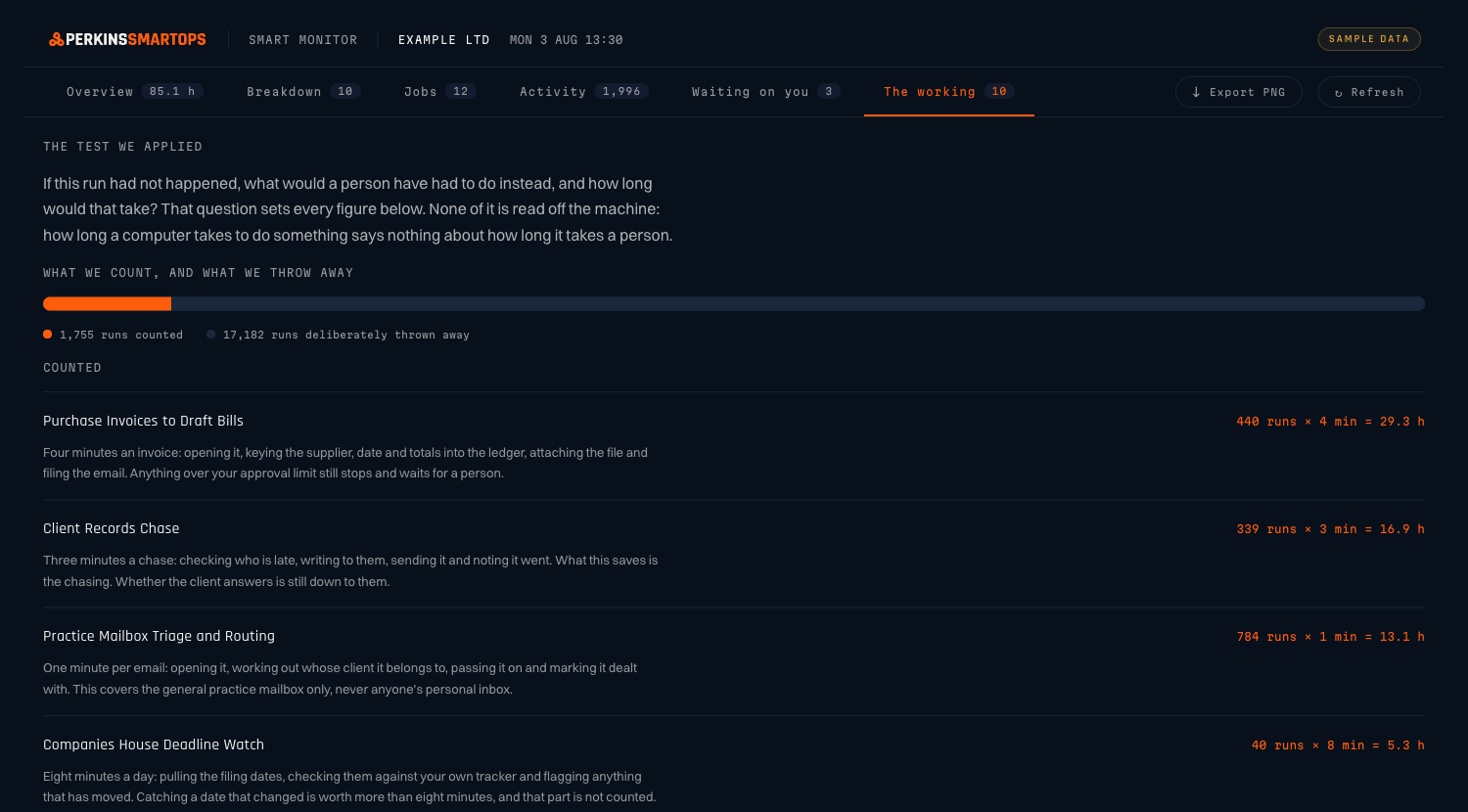
Once the work has a shape, you can put a time against it, because you can answer the only question that matters: if this run had not happened, what would a person have had to do instead, and how long would that have taken them? That question is the whole method. Notice what it is not. It is not how long the computer took. How fast a machine does something tells you nothing about how long it takes a person, and any figure built on machine time is measuring the wrong thing.
How do you work the number out?
Before the build, not after. Doing it afterwards turns it into marketing.
Then it is arithmetic anyone can follow. Runs multiplied by minutes gives you hours. Hours multiplied by an hourly rate gives you money. For the rate, the Office for National Statistics publishes median hourly pay by occupation each October, and the national full-time median was £19.67 an hour in April 2025. Use the rate for the person who actually does the job and you have a figure somebody can check rather than take on trust.
The discipline is in what you refuse to count. If a run would never have happened manually, it saved nobody anything and it does not go in the total. Sample screen below, showing what that looks like when it is written down per job.
How will I know it is working?
You should not have to ask anybody. Three things make that true, and none of them is exotic.
The automation platform is your own account, so you can log into it and look at the run history whenever you like. Failures raise an alert rather than sitting quietly, so the normal state is silence and something arriving means something needs attention. And a monitoring screen turns the run history into the numbers you actually care about: hours saved, money saved, how many runs completed, how many ran clean, and what is paused and waiting for a person.
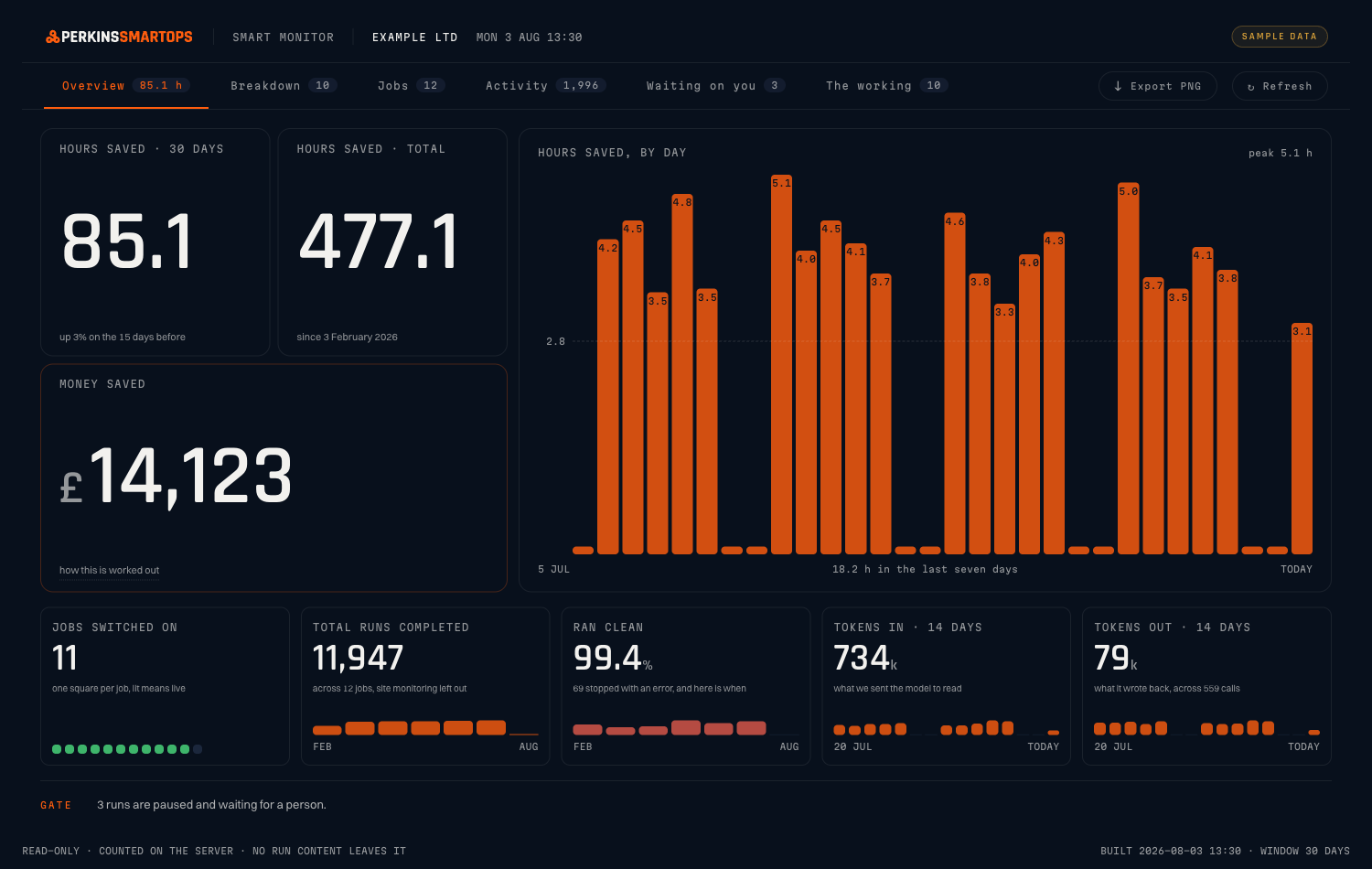
A monitor like this counts runs on your own server and stores counts, not the contents of the work. Worth checking, because the two are very different things. The same question applies to the automation itself: send the model only the fields the job needs, use a business tier that contractually does not train on your data, and if the work is sensitive enough, run the model on your own infrastructure with the data staying in the United Kingdom or Europe.
Does saved time become money?
Only if the time gets spent on something else. Give somebody three hours back and let them fill it with more of the same work, and you have paid for a build that changed nothing.
That is a business decision and not a technical one, which is worth being clear about on both sides. What a build can honestly tell you is that your staff should have this many hours back, starting from this date. What happens to those hours is the owner’s call: more time with customers, the work that has been waiting for months, or a person who simply stops doing the grinding parts of their day.
Two of those answers get dismissed too quickly. If the job being automated is one where a mistake is expensive, the point of the build was never the hours, it was removing the chance of getting it wrong at four o’clock on a Friday. And if your people are already stretched, taking the dullest, most repetitive hour off them has a value that does not show up as time at all. It shows up as somebody still being there next year. Neither of those needs to pretend to be a cash saving to be worth doing. What none of them survives is nobody deciding, because an unspent hour is not a saving.
What should I ask a supplier?
Three questions, and they are all fair to ask before you sign anything.
Show me the arithmetic before you build, with the minutes and the rate written out. Can I see the runs myself, in an account that belongs to me. And when it breaks, who finds out first and how fast. A supplier who can answer those is giving you a number. A supplier who cannot is giving you a claim.
- A chatbot saves real time and hides it, because the task around it is still manual.
- Automation gives the work a shape, and a shape can be counted.
- The test for every figure is what a person would have done instead, and how long it would have taken them.
- Work the saving out before the build, using published pay rates and a written basis.
- You should be able to see the runs yourself, in your own account, without asking anyone.
- Hours only turn into money if the business decides what to do with them.
Drafted by Otto, the Perkins SmartOps AI assistant. Reviewed, edited and published by David Perkins, the human.